

How To Repair Metal Marquetry
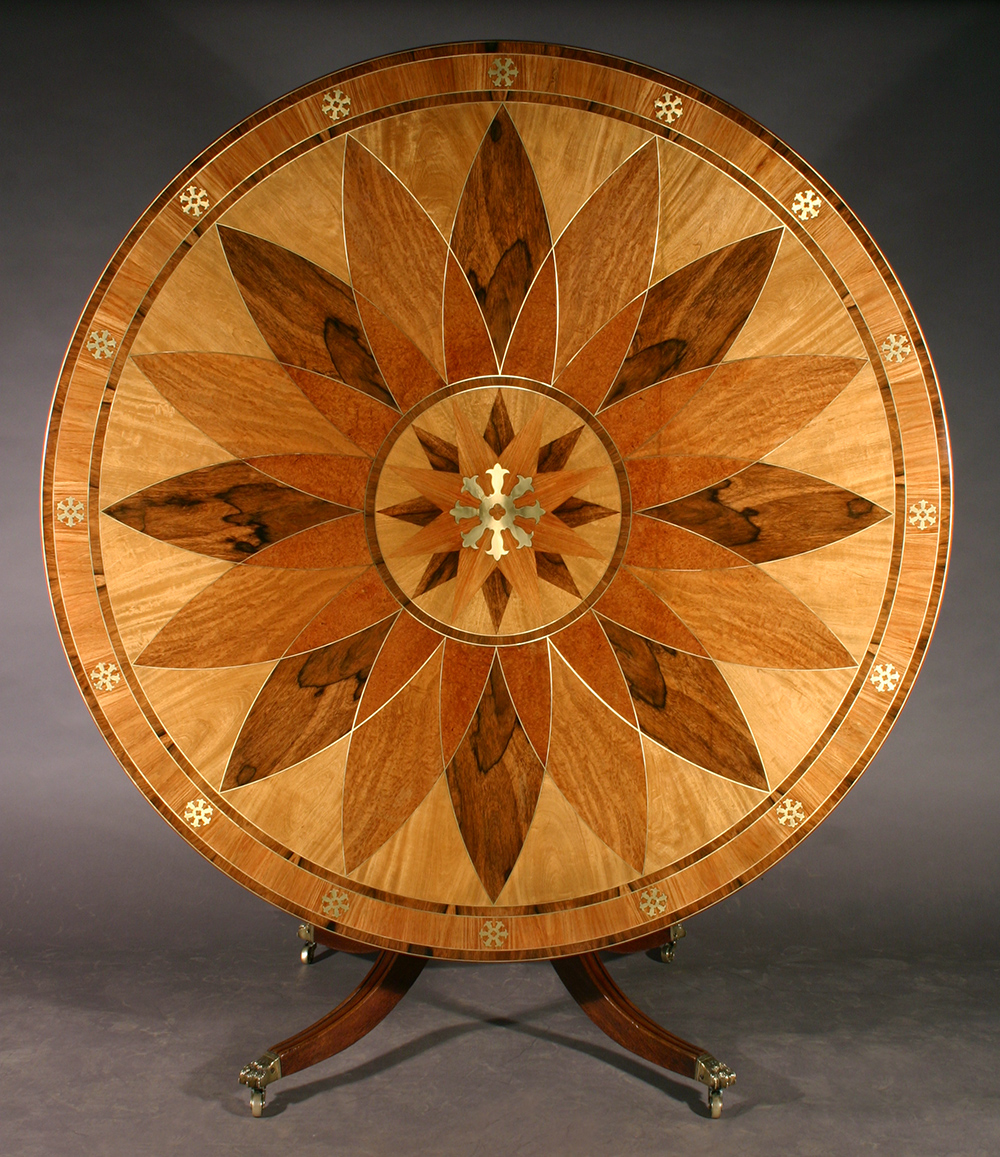
This rosewood marquetry table exemplifies many design elements of the Regency style, an English furniture style dominant between 1800 and 1830. The round table elevation is attached to a pedestal base supported by splayed legs terminating in lion'southward mitt feet, all of which are feature of the Regency way. The brass inlay decoration was also a popular feature during this catamenia. Symmetry was another important component of Regency pattern. Close test of the inlaid ornament reveals the pieces of veneer used for the large dark petals were cutting from the aforementioned piece of forest. The use of the nearly identical cuts of veneer placed contrary each other further demonstrates the importance of symmetry in the limerick. The tilt-top table blueprint allows the top to be tipped into a vertical position, either to salvage infinite or brandish the decorative blueprint on the tabular array top.
Status


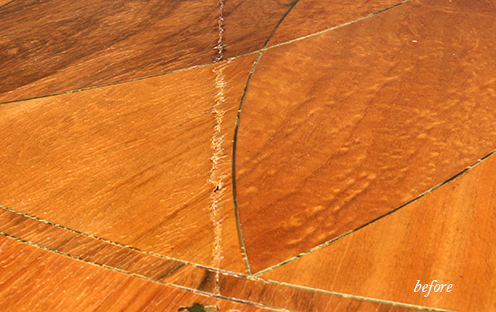
The tabular array top was severely warped and the warping had dramatically distorted the shape of the table top. At that place were ii large cracks associated with the warping which ran across the tabular array pinnacle through both the veneer and solid wood substrate. Warping is generally caused past the shrinking and expanding of wood caused past the loss and absorption of moisture with shrinkage being inevitably the worst. On a piece of piece of furniture such equally this, there are many layers and inlays of unlike materials that react differently to moisture and temperature changes and the subsequent movement and stresses.
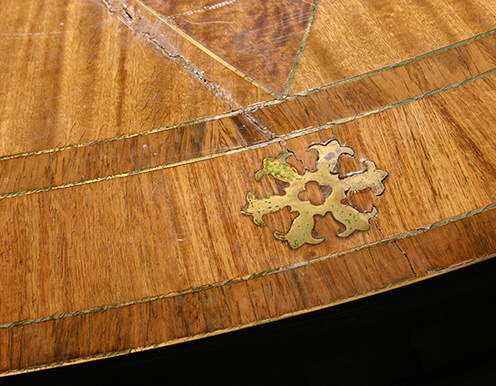
The marquetry blueprint suffered from diverse forms of damage. The veneer used for the inlaid design was cracked and delaminating throughout the tabular array superlative. Additionally, many of the metallic inlays were lifting. Dark greenish corrosion was visible on the surface of each of the star-shaped metal inlays.
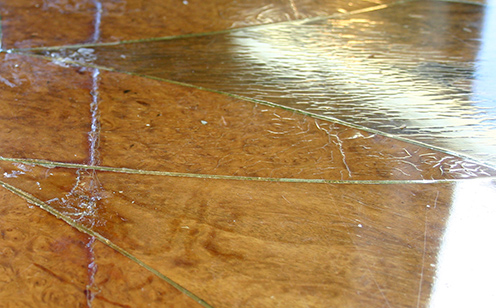
The finish was very thick, cracked, and was crazing throughout. This damage along with discoloration flattened and obscured the marquetry design.
The finish and marquetry surfaces of the top could not exist treated satisfactorily without taking care of the warping and extreme great. Treating only the warping and separation nifty would betrayal more areas of delaminating veneer and metal inlays and practise more damage to the cease. Sometimes a minimal treatment is possible, in this case non treating the underlying structural problems would doom any surface repairs to quick and inevitable failure. Luckily in this instance we had a client that understood this and approved the total treatment.
Handling
Structure

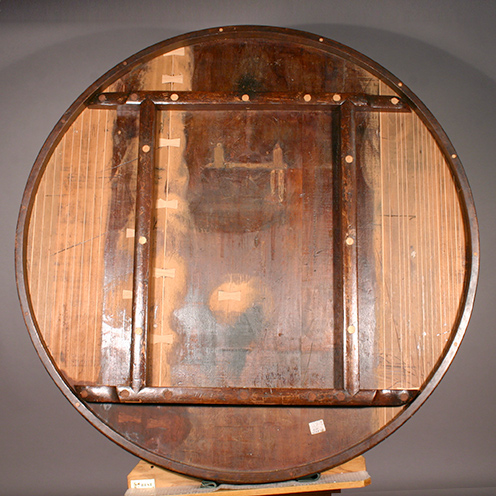
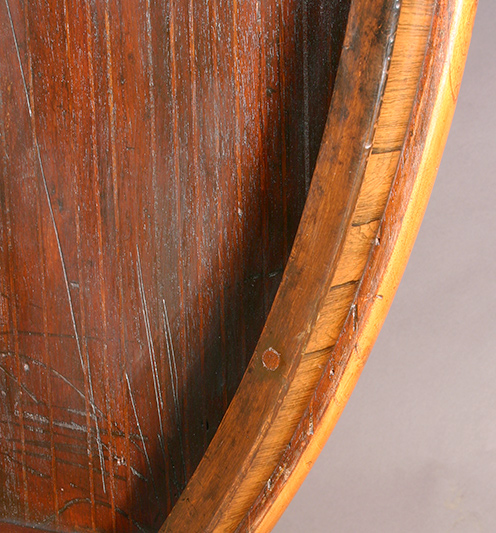
Treatment of the tabular array required many months. The first stride was to return the warped top to its original profile and stabilize the large cracks. The top was disassembled from the pedestal and the frame and apron were removed from the underside of the table pinnacle to let admission for structural repairs. Several butterfly reinforcements were installed underneath the table top along the cracks to stop further separation.
After the cracks were repaired, the warped areas were treated. Grooves were cut into the underside of the solid wood substrate and long wedges of woods were inserted into the grooves. This forth with a combination of heat, moisture, and gradually applied mechanical pressure level allowed the compression of the table elevation dorsum to its original form. A lacquer sealer was applied to the underside of the tabular array peak as a protective barrier coat to avoid moisture transfer and prevent future warping.
Once the structural repairs were applied to the underside work began on the superlative. All accessible loose and delaminating veneer was reattached. The losses along the cracks were filled with forest where e'er possible and filler where not.
Decoration and Cease
Subsequently the structural repairs were applied to the underside and the veneer was stabilized every bit much as possible the finish could be safely removed. The surface was done with the minimal amount of solvent necessary to remove the deteriorating end without removing the wood patina. The surface was gently sanded and the corrosion was removed from the brass inlays. At each of these steps, the veneer was checked to meet if any additional consolidation was necessary.

In-filling missing veneer and stabilization
Additional Challenges
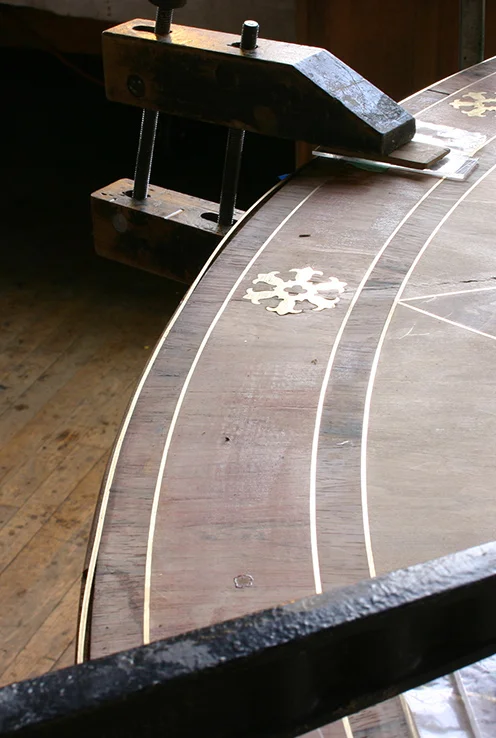

Frequently when extensive repairs are washed, additional obstacles arise. In this case, the metallic inlay lifted in several areas afterward the top was reshaped. The shrinkage of the woods left the contumely rings too long to fit into their original settings. In order to accommodate the length, minimal cuts were made to the brass rings.

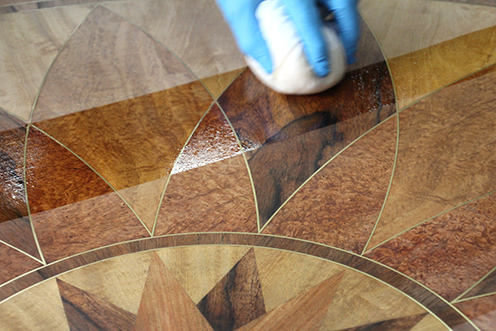
One time all of the wood and metal surfaces were stable the finish could exist treated. All areas of repair and in-fills were toned to match the surrounding original finish. A new finish was practical over the entire pinnacle using a French smoothen technique. This technique employs hand rubbing shellac, an alcohol-based finish.
Results
The structural handling of the warped height improved stability and will reduce further deterioration. The cracks across the table summit remain visible, but do not disrupt the marquetry design.
Removing the old, thick deteriorated finish and applying new finish brought out the contrast of the different woods species. The removal of corrosion improved the clarity of the design by enhancing the brightness of the brass stars and outlines and adds longevity to the metallic. Overall, the handling was a success by returning the table to a stable and functional piece of piece of furniture with a striking design restored to its original splendor.



How To Repair Metal Marquetry,
Source: https://www.conservation-design.com/treatment-of-a-regency-style-marquetry-table
Posted by: currierbied1942.blogspot.com
0 Response to "How To Repair Metal Marquetry"
Post a Comment